

If you play sport and rely on corrective eyewear, prescription sports glasses in Sydney could be one of the most important health decisions you make. Standard fashion frames were never designed for physical activity. They slip, break easily, and leave your eyes dangerously exposed. Yet many Sydney athletes — from weekend runners along the Parramatta River to competitive basketballers at local clubs — still rely on regular glasses or simply squint through blurred vision. That choice carries real risks. This guide covers exactly what makes sports eyewear different, who genuinely needs it, how it compares to contact lenses, and why getting the fit right matters more than most people realise.
Sports vision is a specialised area of optometry. It goes beyond simply improving clarity. Properly fitted sports eyewear addresses peripheral vision, reaction time, depth perception, and eye safety. For anyone living and training in Sydney, understanding these distinctions can directly affect both performance and long-term eye health.
Why Standard Glasses Fall Short on the Field
Most everyday glasses use acetate or metal frames designed for comfort during sedentary activities. On a sports field, those same frames become liabilities. They slide down during a sprint. They shatter on impact. The lenses — often made from standard CR-39 plastic — can crack and send sharp fragments toward the eye in a collision.
Furthermore, standard frames have a narrow field of view. Peripheral vision suffers, which is critical in team sports like football and basketball. For a player who already wears glasses, that limitation directly affects their awareness of teammates, opponents, and incoming objects.
In contrast, purpose-built sports frames use polycarbonate or Trivex lenses, which are dramatically more impact resistant. According to Optometry Australia, polycarbonate lenses are up to ten times more impact resistant than standard plastic lenses, making them the recognised standard for protective eyewear across Australian sporting and occupational settings.
Verified Fact — Optometry Australia
Polycarbonate lenses are approximately 10 times more impact resistant than standard CR-39 plastic lenses. They are the recommended lens material for sports and safety eyewear across Australia.
Additionally, sporty wraparound designs keep the frame stable during rapid head movement. Rubberised nose pads and temple grips ensure the frame stays in position, even during intense sweating. These are not cosmetic features — they are functional necessities.
Impact-Resistant Polycarbonate Lenses — What the Material Actually Does
The term impact resistant polycarbonate lenses appears frequently in sports eyewear discussions. Understanding what it means helps you make a smarter purchasing decision. Polycarbonate is a thermoplastic material originally developed for aerospace applications. Its molecular structure absorbs and distributes impact energy rather than fracturing. That property makes it the gold standard for sports eye protection in Australia.
Beyond impact resistance, polycarbonate lenses also offer inherent UV protection. They filter 100% of UVA and UVB radiation without requiring additional coatings. For outdoor sports in Sydney — where UV levels are among the highest in the world — that built-in protection is genuinely significant.
Trivex is a newer alternative material. It shares polycarbonate’s impact resistance while offering slightly superior optical clarity. For people with high prescriptions, Trivex often produces less peripheral distortion. Your optometrist at Drummoyne Optometry can advise which material best suits your prescription strength and chosen sport.
“Clear, stable, corrected vision during sport is not a luxury. It is a safety requirement. The right lens material makes that possible without compromise.”
Prescription Sports Glasses vs Contact Lenses — A Genuine Comparison
The debate around prescription sports glasses vs contact lenses is one of the most common conversations in sports optometry. Both options have genuine advantages, and the right choice depends heavily on the sport, environment, and individual eye health. Neither is universally superior.
Where Contact Lenses Excel in Sport
Contact lenses sit directly on the eye. Consequently, they offer an unobstructed field of vision with no frame edges to limit peripheral awareness. For sports where visual field breadth is critical — such as football, rugby, and basketball — that advantage is meaningful. Contacts also carry no risk of frame breakage during a collision. Additionally, they pair naturally with non-prescription sports sunglasses and goggles, offering UV and impact protection without lens customisation costs.
However, contact lenses introduce their own set of risks in sport. Dust, grass, and perspiration can migrate under the lens and cause significant discomfort. Outdoor environments in Sydney — particularly near the coast or during high wind days — elevate the risk of dryness and lens displacement.
Where Sports Glasses Outperform Contacts
For contact sports and aquatic environments, dedicated prescription glasses become the safer choice. Contact lenses should never be worn while swimming, as water exposure carries serious risk of eye infection from waterborne pathogens, including Acanthamoeba, a rare but severe corneal infection documented in Australian cases by the NSW Health authority.
Sports glasses also require no daily replacement, carry no infection risk from handling, and provide continuous eye protection even if a ball or elbow makes unexpected contact with the face. For children especially, that physical protection is critical. Young players rarely anticipate impacts the way adult athletes do, and their reaction windows are shorter.
| Consideration | Contact Lenses | Prescription Sports Glasses |
| Peripheral vision | Excellent — no frame border | Very good with wraparound designs |
| Eye protection from impac | None | High — polycarbonate absorbs impact |
| Suitable for swimming | No — infection risk | Yes — with prescription swim goggles |
| UV protection | Varies — not all contact lenses | Yes — built into polycarbonate |
| Stability during activity | Excellent | Excellent with rubberised grip fit |
| Infection or contamination risk | Moderate in dusty/aquatic environments | None |
| Ongoing cost | Daily/monthly replacement | One-off investment |
| Suitable for children | Age-dependent | Yes — from young ages with correct frames |
Many Sydney athletes ultimately use both. They wear contact lenses for training sessions in controlled environments and switch to prescription sports glasses for outdoor weekend fixtures, contact sports, or aquatic activities. Your optometrist can help you build a vision plan around your actual lifestyle.
Running with Astigmatism — Why the Right Glasses Change Everything
Astigmatism is extremely common among the Sydney population. According to the Australian Institute of Health and Welfare, refractive errors — including astigmatism — affect a significant proportion of Australians and are a leading cause of correctable vision impairment. Astigmatism causes blurring and distortion at multiple distances. During running, that distortion affects depth perception and can make uneven ground harder to judge.
Finding the best glasses for running with astigmatism requires more than selecting a sporty frame. The lens must incorporate a correctly oriented toric correction matched precisely to the axis of the astigmatism. Additionally, the wrap angle of the frame matters. Highly curved sport frames can introduce unwanted prismatic distortion unless the lenses are designed with compensated optics for that curvature.
At Drummoyne Optometry, a comprehensive eye test includes precise astigmatism measurement. That information informs the exact lens prescription and helps identify which frame geometry will deliver stable, comfortable vision during your chosen activity.
Verified Fact — Australian Institute of Health and Welfare
Refractive errors, including astigmatism, are among the leading causes of preventable vision impairment in Australia. Correcting them with appropriate eyewear directly supports daily performance and safety.
Sports Goggles for High Prescriptions — What You Need to Know
People with high prescriptions often assume sports eyewear is not available for them. That assumption is outdated. Sports goggles for high prescriptions are now widely available through specialist optometry practices, though they require careful lens selection and frame fitting.
High-index lens materials allow strong prescriptions to be produced in thinner, lighter profiles. This matters significantly in a sports frame, where lens weight directly affects comfort during extended wear. Trivex and polycarbonate are both available in high-index options, and your optometrist can confirm the best material for your specific prescription strength.
Additionally, some sports goggle systems use an Rx insert positioned behind a non-prescription outer shield lens. This design — referred to as an Rx insert sports sunglass system — allows you to use premium sports-specific outer lenses with full tint, polarisation, and UV protection, while a removable inner frame carries your prescription. This system is particularly popular among cyclists and skiers.
Can You Get Prescription Sunglasses for Sport? Absolutely.
One of the most frequent questions asked by Sydney patients is: can you get prescription sunglasses for sport? The answer is straightforwardly yes — and the options are broader than most people expect. Prescription sunglasses designed for sport combine corrective lenses with tinted, polarised, or photochromic outer lenses. Each lens type serves a different purpose.
- Polarised lenses reduce glare from water, wet roads, and glass surfaces — ideal for open-water swimming and coastal cycling in Sydney.
- Photochromic lenses automatically darken in sunlight and lighten in shade — well suited to trail running and sports with changing light conditions.
- Fixed tints offer consistent glare reduction — popular for cricket, tennis, and cycling where light conditions are predictable.
Furthermore, polarised lenses are particularly valued by athletes who train or compete near the water, including surfers, kayakers, and sailors who train along Sydney Harbour. The glare reduction on reflective water surfaces is dramatic and measurably improves both safety and visual comfort.
Verified Fact — Cancer Council Australia
Australia has one of the highest rates of UV radiation in the world. The Cancer Council Australia recommends wearing close-fitting, wraparound sunglasses that meet the Australian Standard AS/NZS 1067 for maximum UV protection during outdoor activity.
Prescription Swimming Goggles in Sydney — A Practical Guide
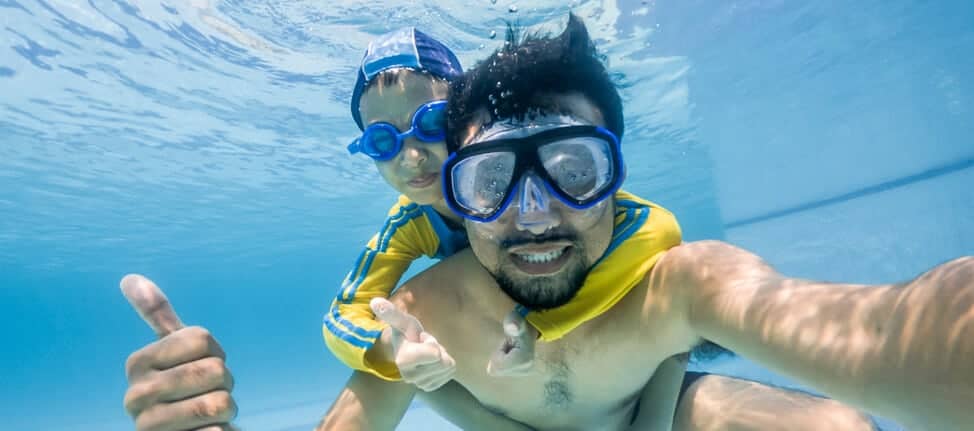
Swimming is one of Sydney’s most popular activities. The city’s coastal lifestyle, harbour pools, and world-class aquatic centres make it a natural part of life for residents across the inner west and broader metro area. For vision-corrected swimmers, prescription swimming goggles in Sydney represent the only safe and practical solution for clear underwater vision.
Standard contact lenses must never enter pool, ocean, or lake water. Waterborne microorganisms can penetrate behind the lens and cause serious corneal infections. Prescription swim goggles solve this completely. They are available in standard powers covering a wide range of prescriptions, and some manufacturers offer custom-ground lenses for complex prescriptions including astigmatism.
Prescription swimming goggles also provide UV protection in outdoor pools and open water environments. Choosing the correct lens tint — clear for indoor pools and tinted or mirrored for ocean swimming — further improves visual comfort and safety.
Drummoyne Optometry’s contact lens and vision care team can advise on the best aquatic vision options for your prescription and swimming environment.
Basketball and Football Players — Getting the Right Eyewear Fit
Contact sports like basketball and football demand eyewear that stays securely in place during intense physical play. Frames designed for glasses for basketball and football players must meet several practical requirements simultaneously.
First, the frame must be close-fitting without creating pressure points that cause headaches during extended play. Second, rubberised grip surfaces on the nose bridge and temples must prevent movement during running, jumping, and physical contact. Third, the lens must be either recessed within the frame or protected by a secondary shield to reduce direct impact exposure to the eye.
Many sports optometry frames for contact sports feature a strap or elastic band to replace standard temples entirely. This configuration eliminates the risk of a temple arm becoming dislodged and causing injury during a collision. It also provides a more secure, stable fit over extended match periods.
Learning how to fit sports glasses properly is an essential part of the purchase process. An ill-fitted frame, regardless of lens quality, will not perform as intended. At Drummoyne Optometry, every sports eyewear fitting includes adjustment of nose pads, temple length, and strap tension to ensure optimal stability for your specific face geometry.
Anti-Fog Sports Lens Coating — Does It Actually Work?
Fogging is one of the most common complaints among athletes who wear glasses during sport. The issue occurs when warm, moist air from the face contacts a cooler lens surface, causing condensation. For cyclists, swimmers, and winter sport athletes, this problem directly obstructs vision at critical moments.
Anti-fog sports lens coatings address this through a hydrophilic treatment layer that spreads moisture evenly across the lens rather than allowing droplets to form. The result is a clear, fog-free surface even during high-intensity activity. Some coatings are permanent factory-applied treatments. Others are periodic sprays that require reapplication.
For enclosed sports goggles — such as those used in squash or racquetball — ventilation design works alongside anti-fog coatings to maintain airflow across the lens interior. Choosing a frame with well-positioned ventilation ports prevents moisture build-up during prolonged indoor play.
When selecting your next pair of sports glasses, ask specifically about anti-fog coating durability. Some lower-cost treatments degrade after a few months of regular cleaning. Premium factory treatments generally last the lifetime of the lens and do not compromise optical clarity.
Children’s Sports Vision in Sydney — Protecting Young Eyes Early
Children are among the most vulnerable group for sports-related eye injuries. Their natural enthusiasm for physical activity, combined with developing spatial awareness, increases the frequency of accidental facial impact during sport. In Australia, children’s sporting organisations are increasingly recognising the importance of mandatory protective eyewear in certain sports — particularly squash, where ball velocity creates extreme injury risk.
For children who need vision correction, choosing safe, comfortable, and properly fitted sports frames is not optional — it is essential. Polycarbonate lenses are the only appropriate choice for active children. They meet the Australian Standard AS/NZS 4066 for occupational protective eyewear, which sports optometrists commonly reference for youth sports frame selection.
Beyond injury protection, uncorrected vision in children during sport can affect their confidence, their ability to track the ball, and their overall participation enjoyment. A child who consistently misjudges distances or loses a ball in flight may be experiencing uncorrected vision rather than simply being unathletic.
Drummoyne Optometry’s children’s vision service provides comprehensive vision assessments specifically designed to identify refractive errors, eye teaming problems, and developmental vision conditions that may affect sport performance. Early identification makes a measurable difference.
Verified Fact — Optometry Australia
Optometry Australia recommends that children receive their first comprehensive eye examination before starting school and then every two years thereafter, or more frequently if vision problems are suspected during sport or learning activities.
Sports Vision Testing in Sydney — What the Assessment Involves
A standard vision test measures your refractive error and the health of your eyes. A sports vision assessment goes considerably further. It evaluates the visual skills that directly affect athletic performance — skills that a routine eye test does not address.
Specifically, a sports vision testing appointment at Drummoyne Optometry includes evaluation of:
- Dynamic visual acuity — your ability to see clearly while both you and the target object are moving
- Contrast sensitivity — your ability to distinguish objects against low-contrast backgrounds
- Eye tracking and pursuit — your ability to smoothly follow a moving object
- Depth perception — your ability to accurately judge distance, critical in ball sports
- Peripheral vision — your awareness of objects and players in your visual field outside the central line of sight
- Reaction time — the speed at which you respond visually to a changing stimulus
Understanding your personal visual profile allows your optometrist to recommend targeted correction strategies — whether through prescription sports glasses, specific lens designs, vision training exercises, or a combination of approaches.
Explore our dedicated sports vision service page to learn more about how Drummoyne Optometry approaches sports vision assessment and correction.
Choosing the Right Frames and Lenses at Drummoyne Optometry
Selecting the right frames involves more than visual preference. The frame must accommodate your prescription, suit your primary sport, and fit your face geometry correctly. At Drummoyne Optometry, our frames and lenses service includes guidance on sports-appropriate frame selection, lens material choice, and specialty coatings.
Key considerations when selecting sports frames include:
- Frame size and wrap angle relative to your prescription strength
- Nose and temple grip design for stability during your specific activity
- Lens tint and coating combination for your training environment
- Whether you need a single pair for one sport or a versatile option for multiple activities
- Whether an Rx insert system or direct prescription lens fits your needs better
Frequently Asked Questions About Prescription Sports Glasses
Conclusion — Clear Vision Is a Competitive Advantage
Prescription sports glasses are not simply a niche product for elite athletes. They represent a practical, evidence-supported solution for any Sydney resident who plays sport and needs vision correction. From protecting children’s eyes on the school oval to improving your depth perception on a weekend cricket pitch, the right sports eyewear genuinely changes how you experience physical activity.
Whether you need anti-fog coatings for indoor sport, polarised lenses for coastal cycling, or high-prescription goggles for aquatic activity, the options available in 2026 are more varied and more accessible than ever before. The key is working with an experienced optometrist who understands both your prescription and your sporting life.
At Drummoyne Optometry, we combine thorough clinical assessment with practical sports vision expertise. Our team serves the Sydney community from Drummoyne and the surrounding inner west, helping patients of all ages and prescription levels find eyewear that genuinely supports their active lives. Discover more about our full range of vision care services at drummoyneoptometry.com.au.