

Finding the right sport frames for prescription glasses is one of the smartest investments any active person in Sydney can make. Whether you play weekend cricket at Drummoyne Oval, cycle along the Iron Cove shared path, or take your kids to Saturday morning football, clear and stable vision makes a genuine difference to performance and safety. Standard glasses simply were not designed to handle sweat, impact, or rapid movement. That is why specialised sports eyewear exists as a separate product category with its own materials, fit principles, and lens technology. This guide covers everything you need to know, from frame materials and face shape compatibility to anti-slip features and high-prescription lens options, all from the perspective of professional optometric care in Sydney.
Verified Fact – Optometry Australia
According to Optometry Australia, eye injuries are one of the leading causes of preventable vision loss in Australia. Appropriate protective eyewear, including sport-specific frames, significantly reduces injury risk during physical activity.
Why Standard Frames Fall Short During Physical Activity
Most standard prescription frames are designed for sedentary and low-movement use. They work brilliantly in an office or classroom. However, they present real problems the moment you start running, swimming, or playing contact sport.
Standard frames typically lack grip on the nose and temples. They slide forward when you sweat. Their lenses are often made from basic plastic materials that can shatter on impact. Moreover, their narrow field of view does not serve peripheral vision the way a wraparound sport frame does. For active Sydneysiders, these limitations translate directly into distraction, discomfort, and risk.
Specifically, there are three critical differences that set sports frames apart. First, the frame construction is impact-resistant and flexible. Second, the lens material is engineered to handle forceful contact without shattering. Third, the fit system is designed to stay on your face regardless of movement, sweat, or outdoor conditions.
“Vision is your primary performance tool in any sport. Compromising it with ill-fitting or inappropriate frames is a risk that is entirely avoidable with the right professional guidance.”
Understanding Frame Materials: TR90 Versus Polycarbonate for Sport
When comparing TR90 versus polycarbonate sports frames, both materials offer genuine advantages. However, they serve slightly different needs. Understanding the difference helps you make a confident, informed choice with your optometrist.
TR90 – Lightweight Flexibility for Comfort-Focused Athletes
TR90 is a thermoplastic polyamide resin that offers exceptional lightness and flexibility. Furthermore, it returns to its original shape after bending. This makes it ideal for runners, cyclists, and gym athletes who prioritise long-wearing comfort above all else. TR90 frames typically weigh between 14 and 20 grams, making them nearly imperceptible during extended wear.
Additionally, TR90 resists temperature changes well. This matters for Sydney athletes moving between air-conditioned gyms and warm outdoor environments. The material will not warp or soften in the heat, which maintains consistent fit across conditions.
Polycarbonate – Impact Resistance for Contact Sports
Polycarbonate frames deliver superior impact resistance. According to the Therapeutic Goods Administration, polycarbonate is widely used in protective optical applications because of its high resistance to fracture. For contact sports such as football, basketball, and martial arts, this impact resistance is essential rather than optional.
Polycarbonate is also used in lens manufacturing. Polycarbonate lenses are roughly 10 times more impact-resistant than standard plastic lenses. They are also naturally UV-blocking, which adds an extra layer of protection for outdoor athletes in Sydney’s often intense sun.
| Feature | TR90 Frames | Polycarbonate Frames |
| Weight | Very lightweight (14-20g typical) | Moderate (20-30g typical) |
| Flexibility | High – memory-return flex | Moderate – rigid structure |
| Impact Resistance | Good | Excellent |
| Best Suited For | Running, cycling, gym, swimming | Contact sports, cricket, football |
| High Prescription Compatibility | Moderate | High |
| Temperature Stability | Excellent | Good |
| Cost Range (approx.) | Mid-range | Mid to Premium |
Source: Materials data based on published optical industry standards. Consult your optometrist for specific recommendations.
Wraparound Sport Frames Versus Standard Frames – Which One Suits You?
The debate around wraparound sport frames versus standard frames comes down to one primary question: how active are you, and in what conditions? Both frame types can carry prescriptions. However, their performance characteristics differ considerably.
Wraparound frames curve around the face at the temples and across the brow. This delivers several clear advantages. First, they block peripheral wind and debris, which matters during cycling and running. Second, they increase the field of view, allowing athletes to track movement at the edges of their vision. Third, they reduce air turbulence around the eyes, which is particularly helpful for contact lens wearers in windy outdoor conditions.
However, wraparound frames do carry one important technical limitation. Their curved base creates optical distortion for wearers with strong prescriptions. Specifically, prescriptions above roughly plus or minus four dioptres may experience a “swim” effect through the peripheral portions of a heavily curved lens. Your optometrist at Drummoyne Optometry can advise on lens designs that minimise this effect through compensated optics or flatter wraparound curves.
Standard frames, by contrast, offer a flatter profile that works seamlessly with virtually all prescription strengths. They also tend to integrate more easily with a general wardrobe. For athletes with high prescriptions who want versatile sports eyewear, a standard-curve frame in a durable sports material often represents the best practical compromise.
Anti-Slip Features and Fit – Why Your Frames Must Stay in Place
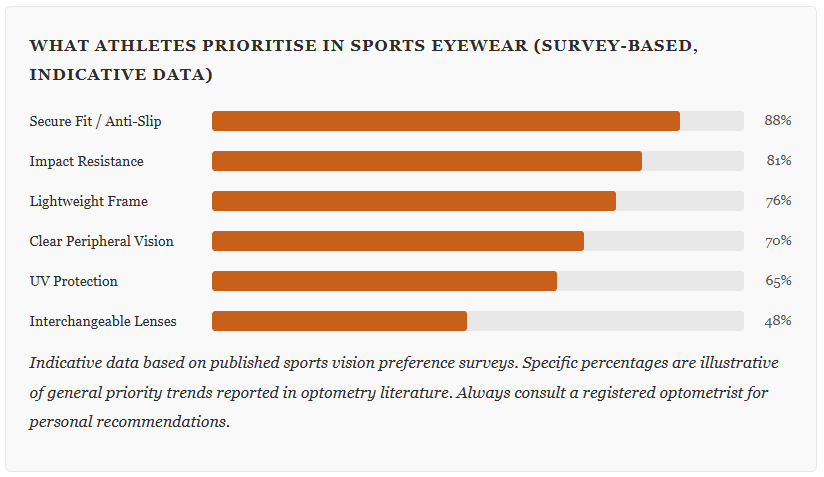
Sport frames that slip on the nose are not just annoying. They actively undermine your performance and can become a safety hazard. Fortunately, modern sports eyewear incorporates several effective anti-slip mechanisms. Understanding these features helps you choose frames that genuinely stay put through intense activity.
Rubber Nose Pads and Temple Grips
Soft rubber or silicone nose pads dramatically increase grip on the skin. Unlike hard plastic nose bridges, rubber pads create friction even against sweaty skin. Similarly, rubberised temple ends grip the skin behind the ears without causing pressure points. Many premium sports frames integrate this rubber across the full inner surface of the temples, providing continuous contact along the side of the head.
Adjustable Nose Pads for a Personalised Fit
Adjustable nose pads on sports glasses are a significant advantage for athletes with narrow, low, or asymmetrical nose bridges. Because everyone’s face is different, a fixed nose bridge often creates pressure on one side while sliding on the other. Adjustable pads allow your optometrist to customise the nose fit precisely. This eliminates the rocking motion that causes frames to creep down your nose during activity.
Retention Straps and Integrated Headbands
For high-impact or water-based sports, retention straps provide an additional level of security. These attach to the temple ends and loop around the back of the head. Some sports frame models go further, offering fully integrated headbands that replace temples entirely. Both options are effective, though the fully integrated headband style tends to suit younger athletes and water sports participants especially well.
Verified Fact – Sports Medicine Australia
Sports Medicine Australia recognises protective eyewear as a crucial element of sporting safety protocols, particularly in ball sports and contact activities. Properly fitted frames with retention systems significantly reduce displacement risk during play.
Choosing the Best Sport Frames for a Narrow Face in Sydney
Finding the best sport frames for a narrow face is a challenge many Sydney patients raise during consultations. Most sports frames are engineered around an average adult face width, which can leave people with narrower features dealing with frames that sit too wide, slide off the nose, and create uneven lens positioning.
Fortunately, several strategies address this effectively. To start, look for frames with an adjustable nose pad system rather than a fixed bridge. This allows lateral adjustment across the nose bridge. Additionally, look for frames with a shorter temple length. Shorter temples sit closer to the head without wrapping excessively. Furthermore, frames in the 125mm to 135mm total width range tend to suit narrower adult faces without compromising lens coverage.
Some frame brands now offer dedicated narrow or petite sport frame ranges. Your optometrist can identify which specific models from the Drummoyne Optometry frames and lenses collection are appropriately sized for narrower facial profiles. Never purchase sports frames online without a professional fitting assessment, as incorrect sizing creates fitting problems that are difficult to correct after purchase.
Rimless Versus Full-Rim Sports Frames – Durability and Performance Compared
The question of rimless versus full-rim sports frames is genuinely nuanced. Both styles carry distinct advantages, and neither is universally superior. The right choice depends on your sport, prescription, and personal preference.
Full-rim frames encircle the entire lens. This provides maximum structural support for the lens, which is especially important for high prescriptions or polycarbonate lenses. Full-rim designs also allow greater customisation of nose pad and temple configurations. Moreover, they tend to be more durable under impact because the rim distributes force around the lens rather than concentrating it at the mounting points.
Rimless frames, by contrast, attach directly to the lens through drilled mounting points. They offer a cleaner aesthetic and are extremely lightweight. However, rimless frames are generally not recommended for contact sports because the mounting points can be stress fracture sites under high impact. For running, cycling, golf, or low-contact outdoor activities, a well-constructed rimless frame in polycarbonate can work effectively. Your optometrist will advise based on your specific prescription and activity.
Sport Frames for Prescription Glasses with High Prescriptions
Managing sports frames for high prescription lenses requires specific expertise. High prescriptions, typically those outside the minus four to plus four dioptre range, create optical challenges in curved or wraparound frames. The lens periphery becomes increasingly distorted as the frame curve increases. This can cause headaches, balance disturbance, and reduced visual clarity in the lens margins.
Several solutions exist specifically for this situation. First, compensated lens designs account for the frame curve in the optical calculation. Second, flatter wraparound frames, sometimes called semi-wrap frames, reduce base curve and therefore reduce distortion while still providing better peripheral coverage than a flat standard frame. Third, prescription sports goggles with flat-front lenses eliminate curve distortion entirely, though they sacrifice the aerodynamic advantages of a wraparound design.
For patients with particularly strong prescriptions, contact lenses combined with a non-prescription sports frame or protective goggle may represent the most optically accurate solution. This combination delivers the visual clarity of a precisely corrected contact lens with the protection and comfort of a purpose-built sports frame. The optometrists at Drummoyne Optometry regularly advise patients on this combined approach.
Lightweight Sports Frames for Kids in Sydney
Children need sport-specific eyewear just as much as adults. In fact, the case for lightweight sports frames for kids is even stronger because children often lack the awareness of risk that develops with age. Sydney schools and sporting clubs across the inner west are increasingly recognising the importance of protective eyewear for junior athletes.
Paediatric sports frames must meet specific criteria. They need to be lightweight enough not to cause fatigue or discomfort during a full game or training session. They also need to be robust enough to survive the rough handling that children inevitably subject their belongings to. Additionally, they need adjustable fit systems because children’s faces change rapidly over short periods.
TR90 frames perform exceptionally well for children because the memory-flex material resists the twisting and bending that occurs when kids take frames on and off quickly between activities. Full-rim designs are strongly preferable over rimless for children because they provide better structural protection and are easier to adjust and repair. For contact sports, polycarbonate-lensed goggles with foam-padded frames are the gold standard in protective paediatric sports eyewear.
Drummoyne Optometry’s children’s vision service includes professional fitting for sport-specific eyewear. Early professional fitting ensures that frames align correctly with developing facial anatomy, which prevents the habitual tilting and frame manipulation that children adopt when glasses do not fit properly.
Interchangeable Lens Sports Frames – Versatility for All Conditions
Interchangeable lens sports frames have grown rapidly in popularity among Sydney athletes who train and compete in varying light conditions. The concept is straightforward. A single frame accepts multiple lens sets, each optimised for specific conditions.
For example, one lens set might be a dark tinted lens for bright midday sun at Sydney cricket grounds. Another might be a clear lens for overcast morning training runs. A third could be a rose or amber tinted lens that enhances contrast in variable afternoon light. By simply swapping lenses, the athlete adapts a single pair of well-fitting frames to almost any condition without purchasing multiple complete pairs of prescription glasses.
However, the prescription aspect of interchangeable lens frames requires careful consideration. Not all interchangeable frame systems accommodate optical-quality prescription lenses in each lens format. Some systems use non-prescription lens cartridges with a separate prescription insert behind them. Others accept fully custom-ground prescription lenses in each interchangeable set. Your optometrist will explain the optical quality implications of each approach and recommend the system that best preserves your visual acuity.
Durable Frames for an Active Lifestyle – What to Look for Beyond the Frame Material
Durability in sports eyewear extends well beyond the frame material. Achieving genuinely durable frames for an active lifestyle requires attention to several components that marketing materials rarely discuss.
Hinge Design and Reinforcement
Hinges represent the most mechanically stressed component of any frame. Standard barrel hinges weaken over time under the repeated flexing of an active lifestyle. Look for spring-hinged systems that absorb temple movement without metal fatigue. Some premium sports frames eliminate hinges entirely, using a monoblock or semi-rimless design that removes this failure point altogether.
Lens Coating Durability
Anti-scratch, anti-fog, and anti-reflective coatings add significant practical value to sports lenses. Anti-fog coatings are particularly important for high-intensity activities that generate body heat, which can fog lenses rapidly in cool morning conditions. Ensure any coating package offered for your sport lenses specifically includes anti-fog treatment, especially if you cycle, row, or play team sports early in the morning.
UV Protection in the Australian Context
Australia’s UV intensity demands genuine UV400 protection rather than basic UV blocking. According to the Cancer Council Australia, the risk of UV-related eye conditions, including cataracts and photokeratitis, is significantly elevated by prolonged outdoor exposure without appropriate eye protection. All sports lenses prescribed at Drummoyne Optometry incorporate UV400 protection as a baseline standard.
Getting a Professional Sports Frame Fitting in Sydney
Professional fitting transforms a good sports frame into a great one. Even the highest-quality frame performs poorly if it does not sit correctly on your face. A professional fitting from an optometrist, rather than a retail assistant, delivers significantly more precise results because it accounts for your prescription, pupillary distance, vertex distance, and pantoscopic tilt simultaneously.
These optical measurements determine where the optical centre of your lens sits relative to your pupil. In standard frames, small misalignments cause mild discomfort and minor visual blur. In sports frames, where the lens sits closer to the face and at steeper angles, the same misalignment can cause significant distortion and eye strain during activity.
Drummoyne Optometry’s comprehensive eye test service includes all measurements required for accurate sports lens prescription and frame fitting. The practice is conveniently located at Shop 2, Sutton Place Shopping Centre, 38-50 Lyons Road, Drummoyne, serving patients across the inner west and broader Sydney area.
Prescription Sunglasses as Dual-Purpose Sport Frames in Sydney
For many Sydney athletes, prescription sunglasses represent an elegant dual-purpose solution. A well-chosen pair of prescription sunglass frames in a sports-appropriate design delivers vision correction, UV protection, and glare control in a single package. This is particularly effective for outdoor sports such as cricket, cycling, surfing, sailing, and beach volleyball where sun exposure is constant.
Polarised prescription lenses are a popular choice for water and road sports because they filter horizontal glare reflected from flat surfaces. However, it is worth noting that polarised lenses can interfere with the readability of certain digital screens, including GPS devices and smartphone displays. Your optometrist can advise on whether polarised lenses suit your specific combination of sports and daily activities.
Photochromic lenses, which darken in response to UV light, also offer an interesting alternative. A single photochromic sports lens adjusts automatically from clear indoors to tinted outdoors. This eliminates the need to carry multiple lens sets. However, photochromic lenses do not darken inside a car because automotive glass blocks the UV that triggers the transition. For athletes who commute to training, this is worth considering.
Frequently Asked Questions About Sport Frames for Prescription Glasses
The Right Sport Frames for Prescription Glasses Make Every Game Better
Choosing sport frames for prescription glasses is not simply a matter of aesthetics or personal preference. It is a practical decision that directly affects your visual performance, eye safety, and comfort during physical activity. Throughout this guide, we have covered the key considerations: frame materials, anti-slip design, prescription compatibility, wraparound versus standard configurations, paediatric eyewear, high prescription solutions, and the importance of professional fitting.
The key takeaway is this: the right sports frame is one that stays on your face, protects your eyes, delivers optically accurate vision through your prescription, and suits the specific demands of your sport. There is no single universal answer. However, there is always a right answer for your individual face, prescription, and lifestyle. Finding it requires a professional conversation with a qualified optometrist.
At Drummoyne Optometry, we work with active Sydney patients every day. We understand the demands of sport, the technical requirements of prescription lenses in sports frames, and the importance of getting the fit exactly right. Whether you are a weekend runner, a competitive cricketer, a junior footballer, or a daily cyclist along the inner west bike paths, we are here to help you see better and train safer.