
A school or preschool vision screening is a useful first check, but it is not the same as a comprehensive children’s eye test. Screening is designed to flag children who may need further assessment. A comprehensive eye examination for children looks more broadly at their vision and eye health, with the exact tests tailored to the child’s age, symptoms and clinical needs.
In New South Wales, the Statewide Eyesight Preschooler Screening (StEPS) program offers free vision screening for four-year-olds. It is an important opportunity to identify possible problems before school, but it does not replace a full assessment when a parent, carer, teacher or health professional has concerns.
If you are wondering whether your child needs a children’s vision test, this guide explains the difference between screening and a comprehensive eye examination, what signs to watch for, and when to arrange a kid’s eye test with an optometrist.
What is children’s vision screening?
Vision screening is a brief check designed to identify children who may have difficulty seeing clearly or who may need a more detailed assessment. It commonly checks visual acuity; how clearly each eye can see at a set distance. The specific screening method depends on the programme and the child’s age.
NSW Health’s StEPS programme provides free vision screening for four-year-old children through participating preschools and long day care centres. If a child misses the visit or does not attend an early childhood service, parents can contact their local StEPS team to ask about options. A GP, child and family health service or optometrist may also help parents work out the appropriate next step.
However, screening is not a diagnosis. A result that suggests a possible issue usually means further assessment is recommended. Likewise, a child passing a screening does not guarantee that every aspect of their vision and eye health is normal.
What is a comprehensive eye test for a child?
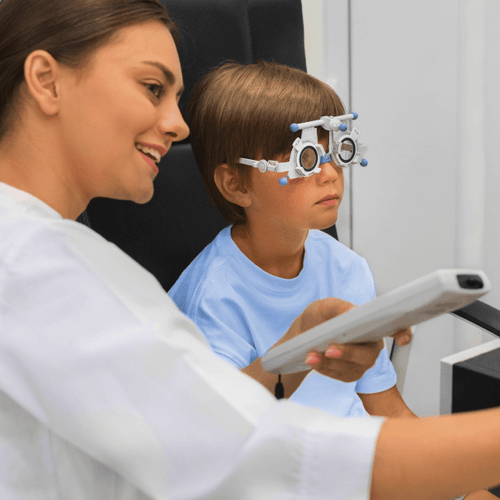
A comprehensive eye examination is a more detailed appointment with an optometrist. The clinician considers the child’s symptoms, health, and family history, and uses age-appropriate tests to assess vision and relevant aspects of eye health. The exact examination varies; not every test is necessary for every child.
Depending on the child’s age and needs, an appointment may include:
- A discussion about symptoms, medical history, development, school or reading concerns, and any family history of eye conditions.
- Visual acuity testing to assess how clearly each eye sees at near and/or distance.
- Assessment of focusing and how the eyes work together, where clinically appropriate.
- Checks of eye movements, alignment and coordination.
- Refraction tests to determine whether glasses may help.
- An examination of relevant eye structures and eye health, with additional tests or referral if indicated.
A child does not need to be able to read letters to have their vision assessed. Depending on their age and communication skills, an optometrist may use pictures, matching tasks, objective measurements, or other child-friendly techniques.
School vision screening vs an eye test: the key differences
| Feature | Vision screening | Comprehensive children’s eye test |
| Main purpose | Flags children who may need further assessment. | Assesses vision and relevant aspects of eye health in more detail. |
| Typical scope | Often a brief visual acuity check; scope depends on the programme. | A tailored set of tests based on age, symptoms and clinical judgement. |
| Who conducts it | A trained screener or programme team, depending on the service. | An optometrist or other appropriate eye health professional. |
| Outcome | Indicates whether follow-up may be needed. | Explains findings and next steps, which may include monitoring, glasses, treatment advice or referral. |
| If the child passes | Reassuring for the areas screened, but not a guarantee that every issue has been ruled out. | Provides a broader assessment, although no examination can guarantee that future problems will not develop. |
| When to use it | As a routine early check, including the NSW StEPS programme for four-year-olds. | If there are symptoms, concerns, risk factors, a screening referral, or a need for a fuller assessment. |
The practical takeaway: Screening and comprehensive eye care serve different purposes. If you have noticed a change in your child’s vision or behaviour, do not wait for the next school screening to raise the concern.
When should a child have their first eye test?
There is no single age that suits every child. NSW Health recommends vision screening before school and strongly recommends that four-year-olds take part in StEPS. A comprehensive eye examination may be appropriate earlier if there are symptoms, developmental concerns, a relevant family history or other risk factors.
Arrange an assessment promptly if a child’s eye appears to turn in or out, if they have persistent visual complaints, or if you are concerned about how they see. Babies and children who were born prematurely, have developmental delays, or have a family history of certain eye conditions may need individual advice from a GP or eye health professional.
Signs of vision problems in children
Children do not always recognise or explain that they cannot see clearly. Sometimes they assume everyone sees the same way they do. Look out for patterns such as:
- Squinting, closing one eye, or tilting or turning the head to see.
- Sitting unusually close to the television or holding books and devices very close.
- Frequent eye rubbing or blinking, especially during close work.
- Headaches or eye discomfort after reading or schoolwork.
- Losing their place, avoiding reading, or struggling with tasks that require sustained near vision.
- Difficulty seeing the board, copying from a distance, or keeping up with visual classroom activities.
- A noticeable eye turn, poor hand-eye coordination, or seeming unusually clumsy.
- A teacher or carer reporting that the child seems to have trouble seeing.
One sign on its own does not prove that a child has a vision problem. However, persistent or repeated signs are a good reason to seek professional advice. If an eye turns suddenly, there is sudden loss or change of vision, a significant eye injury, severe pain, or another urgent symptom, seek urgent medical assessment.
Children’s myopia and vision development
Myopia, also called short-sightedness, means distant objects look blurry while close objects may be clearer. It can develop during childhood and may change as a child grows. Children may not realise that their distance vision is blurred, so parents and teachers may notice the signs first.
Possible clues include difficulty seeing the classroom board, squinting at distant objects, or choosing to sit close to a screen. These signs are not specific to myopia, so an eye examination is needed to understand what is happening.
Outdoor time, regular breaks from prolonged close work, and sensible screen habits are practical parts of a healthy routine. They do not replace an eye test, and parents should ask an optometrist for advice tailored to the child. If myopia is diagnosed, the optometrist can discuss suitable options for correction, monitoring and—where appropriate—myopia management.
What happens during a children’s eye test at Drummoyne Optometry?
A children’s eye test should be adapted to the child, not the other way around. Drummoyne Optometry describes its children’s appointments as a positive, child-friendly experience, typically allowing around 30–45 minutes. A parent or carer is encouraged to stay with the child for reassurance.
The optometrist will consider the child’s age, symptoms and ability to take part, and explain the findings and recommended next steps. A child who is shy, nervous or not yet reading may still be assessed using age-appropriate methods.
Want to know more about what really happens during your visit?
Check this out: comprehensive eye checks at Drummoyne Optometry.
How to prepare your child for the appointment
- Explain simply that the optometrist will check how well their eyes work.
- Bring any glasses your child currently wears and relevant reports or screening results.
- Tell the optometrist about symptoms you have noticed, when they occur and how often they happen.
- Mention any family history of eye conditions, previous eye problems, developmental concerns or relevant medical history.
- If your child is anxious, let the practice know when booking so the team can help make the visit more comfortable.
Frequently asked questions
Book a children’s eye test in Drummoyne
A vision screening is a valuable early check, but it is not a substitute for a comprehensive assessment when you have concerns. If your child squints, complains of headaches, struggles with reading or distance vision, or has been referred after screening, speaking with an optometrist can help you understand what to do next.
Drummoyne Optometry provides children’s vision care from its practice. Visit the children’s vision care page to enquire more, or you may also book an appointment.